As a Protestant, I had to wrestle with these and many other objections about Catholic beliefs and practice on my way back to the Catholic Church. If you are Protestant, whether genuinely curious, vehemently anti-Catholic, or somewhere in between, this will help you to better understand what the Catholic Church actually teaches. If you are Catholic, this will give you confidence to gently respond to family or friends who may challenge your beliefs.
Catholics don’t worship Mary. In fact, when some early Christians began worshiping Mary it was the Catholic Church that condemned the practice and declared Collyridianism a heresy.
Being a mere creature, Mary is infinitely less important than God. But being specifically chosen by God to be the vessel of our salvation, Mary plays a unique role in salvation history. This is why Catholics place such an emphasis on Mary—because Jesus did. Jesus chose to save us through Mary. No one honors Mary more than Jesus, and Catholics simply try to imitate Christ in honoring Mary, who is given to us as our own mother.
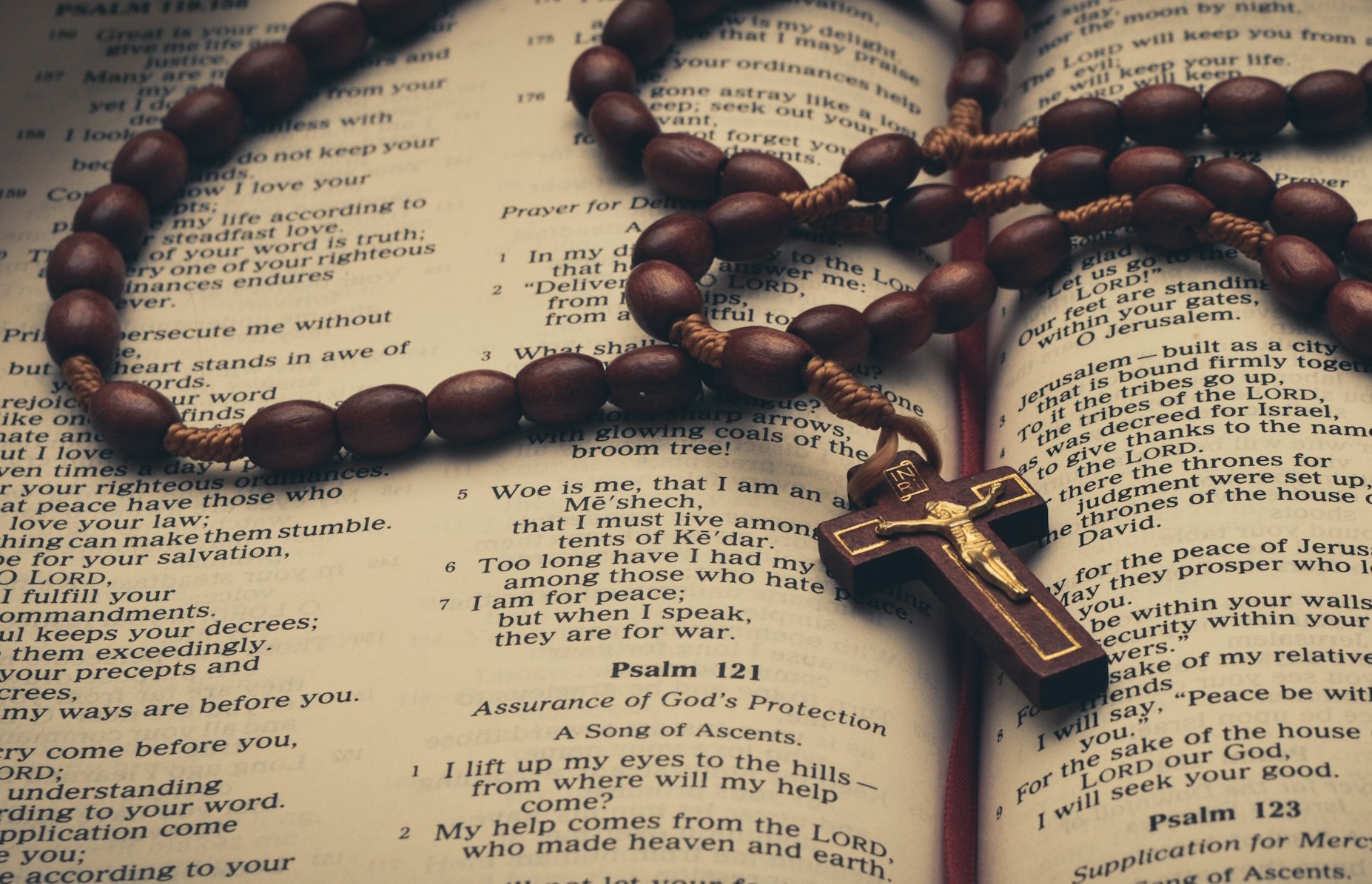
On the cross Jesus said to John, “Behold, your mother!” Just as John “from that hour took her to his own home” (John 19:27), Catholics welcome Mary into their own home and hearts by praying the rosary (which is a beautiful practice of meditating on the life of Christ while reciting Scripture), asking for her intercession, and affectionately addressing her with titles such as “Mother of God” (see Luke 1:43), “Queen of Heaven” (see Rev 12:1), and “Our Lady of Grace.” (see Luke 1:28). Notice how these titles are rooted in Scripture and show Mary’s place of honor only in reference to Jesus, who is God incarnate, the all-powerful King of Glory, and Author of Grace. As the moon emanates no light of its own but simply reflects the light of the sun, so too Mary reflects the light of the Son and continually draws our gaze to our Lord and Savior, Jesus Christ.
Scripture says, “The prayer of a righteous person has great power” (James 5:16). This, of course, does not mean righteous persons are powerful by their own strength; Christians are more or less holy based solely on their conformity or proximity to Christ, the “one mediator.”
The holiest people are our brothers and sisters in heaven, where there is no sin and no separation between the righteous and God. By praying to the saints (which is simply asking for their intercession; God alone is to be worshipped), Catholics simply ask for the help of fellow Christians, the faithful ones who have gone before us who are now perfectly united to Christ in heaven. The saints are cheering us on as we run the race (Heb 12:1) and want to help us, just as our guardian angels (Matt 18:10) protect and assist us, especially when called upon.
The intercessory prayer of the saints in heaven is not only a theoretical possibility but a reality. There are many documented miracles that have occurred due to the intercession of the saints, including a recent incredible story from 2010 that took place in Peoria, Illinois. Bonnie Engstrom delivered a stillborn baby boy, and through the intercession of American bishop and evangelist Fulton Sheen, after 61 minutes without a pulse, the boy came back to life. A panel of seven medical specialists examined the case and James Engstrom, who, despite all odds, developed normally without severe organ failure or disabilities, and determined the case had no known scientific explanation.
But we don’t need to go outside the Bible to find evidence of the intercession of the saints. In the last book of the Bible John tells us “when he had taken the scroll, the four living creatures and the twenty-four elders fell down before the Lamb, each holding a harp, and golden bowls full of incense, which are the prayers of the saints” (Rev 5:8). In Scripture we are told the elders, or saints in heaven, offer the prayers of the saints on earth before Jesus, which is also what the angels do before the throne in heaven (8:3-4).
God alone can forgive sins. But he often chooses to work through his faithful servants to save his people.
Moses’s role in the exodus offers a great example. When the Israelites were fleeing the Egyptians, God commanded Moses to stretch out his hand over the sea twice: once to separate the waters to allow the Israelites to escape, and again to close the waters to kill the enemy. The Israelites recognized that God saved them through Moses. “Thus the Lord saved Israel that day … and they believed in the Lord and in his servant Moses.” (Ex 14:30-31). God didn’t need Moses, but he chose him as his instrument to free his people from slavery.
This is what happens during the sacrament of Confession. God uses his servant, an ordained priest, to save his people from the slavery of sin. When the priest stretches out his hand over the penitent sinner and says the words of absolution, “I absolve you of your sins in the name of the Father, and of the Son and of the Holy Spirit,” it is Christ working through his servant to grant forgiveness of sins.
The power to forgive sins is not granted to everyone but only to the ministerial priests of the New Covenant. After his resurrection, Jesus appeared to his disciples and “he breathed on them and said to them, ‘Receive the Holy Spirit. If you forgive the sins of any, they are forgiven them; if you withhold forgiveness from any, it is withheld’” (John 20:22-23).
The Catechism of the Catholic Church says, “Justification has been merited for us by the Passion of Christ” (CCC 2020). Anyone who is saved is saved by the grace of God. Apart from faith and grace, no one can be saved. We are all sinners in need of God’s mercy.
All of salvation is a free gift of grace. This includes initial conversion by faith, and ongoing conversion involving good works done in faith. Faith and works are both necessary for salvation, and although our cooperation is required, even our cooperation is only possible by grace. The Catechism says, “The saints have always had a lively awareness that their merits were pure grace.” Quoting St. Thérèse of Lisieux, the Catechism continues, “In the evening of this life, I shall appear before you with empty hands, for I do not ask you, Lord, to count my works. All our justice is blemished in your eyes” (CCC 2011). Check out my article on justification to learn more.
Purgatory is the Catholic doctrine that those who die in a state of grace but who have imperfections receive purification before entering heaven. It is not a third option between heaven and hell, which is a common misconception. The eternal destiny is fixed at the moment of death when souls are immediately judged by God; then the reprobate descend immediately to hell, and the elect enter either directly into heaven, or first undergo purification before entering heaven. Everyone in purgatory is saved by the merits of Christ and will one day be united with God in heaven for all eternity.
Scripture says heaven is a place where “nothing unclean will ever enter” (Rev 21:27). The problem is, those of us Christians who are honest will admit we are not free from sin and that our love for God is far from perfect. This is unacceptable as Jesus commands us to “be perfect, as your heavenly Father is perfect” (Matt 5:48).
This is where purgatory comes into play. Purgatory is good news. It is the purifying car wash before entering heaven, allowing our souls to sparkle with perfect holiness without which we would be unworthy to meet our infinitely holy Father face to face. As the Catechism says, purgatory is a “purification, so as to achieve the holiness necessary to enter the joy of heaven” (CCC 1030; see also Heb 12:14). The Church leaves the question open if there is physical fire (see 1 Cor 3:15 for the biblical basis for this idea), and it’s possible the purification is instantaneous since it’s uncertain how time operates after death. But the idea of purgatory has biblical roots spanning back to the Old Testament (2 Macc 12:44-46), and it’s logically necessary for those in a state of grace but who remain imperfect at the moment of death. Imperfections can be due to disordered attachments to things other than God, unconfessed venial sins (see 1 John 5:16-17 for the biblical distinction between mortal and venial sin), and temporal punishment for sins already forgiven (see 2 Sam 12:13-14).
Catholics have a deep reverence for the Bible and fully accept its unique authority as the word of God. It is infallible because God is the author. But the Bible was never meant to be the only authority for Christians. How could it be when the Bible as we know it didn’t even exist until the 4th century? Ironically, sola scriptura, the Protestant idea that our only infallible authority is the Bible, is itself unbiblical.
Because of the Bible’s importance, God, in his loving care for his children, provided a means to ensure the Bible (which, by the way, didn’t drop out of heaven) be free from errant interpretations, which are many and multiplying. He did this by establishing a Church endowed with the authority of Christ to teach the faithful without error.
Correct. Popes are fallible, or able to make errors, just like the rest of us. It’s also true that all popes are sinners and in need of God’s mercy, just like the rest of us. But consider the human authors of Scripture. No one claims that the writers of Scripture were infallible all the time, but Christians believe they were infallible at a particular time: when they were writing Scripture.
That is what Catholics believe about the Pope. The vast majority of the time, just like the writers of Scripture, popes are fallible. But on narrowly defined and specific occasions, when defining beliefs about faith or morals to be accepted by the entire Church, the pope is protected from error by the power of the Holy Spirit.
Jesus said to Peter, “you are Peter, and on this rock I will build my church … I will give you the keys of the kingdom of heaven, and whatever you bind on earth shall be bound in heaven, and whatever you loose on earth shall be loosed in heaven” (Matt 16:18-19). By giving Peter “the keys of the kingdom of heaven” and the power to “bind” and “loose,” he invested Peter, and each successor pope, with his own authority to teach the faithful and resolve disputes in a definitive way without error.
An extended family member once said to me, “Couldn’t it be that God wills all these different denominations to keep us humble? Besides, no one knows everything, and all Christians will be united in heaven.” I would be sympathetic with this line of thinking if disagreements among Christians were limited to secondary issues. But they aren’t. Christians disagree on all sorts of issues, from sacramental theology to specific moral issues, and from the nature of Christ to the content and implications of the gospel itself. Protestants themselves are deeply divided and cannot even agree on the “essentials” necessary for salvation.
God has certainly permitted the fracturing of Christendom, but this is not his will. Jesus prays for perfect unity (John 17:21), not only in heaven but starting here on earth. God wills Christians be perfectly united in beliefs, worship, and practice. That is only possible if heresy can be clearly named and rejected. To paraphrase Catholic convert and writer G.K. Chesterton, we don’t need a church to tell us when we’re right, we need a Church to tell us when we’re wrong. Unlike any of the thousands of Protestant denominations, the Catholic Church has the power to teach with authority so Christians know what to believe, how to worship, and how to live. And it is above all the Mass that brings about this unity, where St. Paul tells us Christians who “partake of the one bread” (i.e., consume the Eucharist, which is the body, blood, soul, and divinity of Jesus in sacramental form), become “one body” (1 Cor 10:17).
It is a matter of humility to accept, as a historical fact, that the Catholic Church is the one Church Jesus established and to join that Church rather than setting up endless new churches made in our own image. Jesus only started one Church, and he promised “the gates of hell shall not prevail against it” (Matt 16:18).
For my Protestant brothers and sisters, first of all, thank you for reading this. It can be difficult to muster up the desire to hear from another perspective, and I want to acknowledge that and express my appreciation. I highly value learning from and having conversations with others who disagree with me, and yet I still find it difficult and uncomfortable.
Maybe this was your first time encountering Catholic responses to some of your objections, and although some objections likely remain or were not addressed here, maybe you realize some of your beliefs about what the Catholic Church taught were caricatures or misconceptions. I sincerely appreciate your openness to learning what the Catholic Church actually teaches and hope this prompts your search for the truth to continue.
To learn more, check out the books below. Several include testimonies of Protestants who relate their difficulties with various Catholic doctrines, and ultimately what convinced them of the truth of the Catholic Church, and others offer book-length defenses of specific Catholic doctrines covered only in summary here. You may also benefit from my article, The Best Way to Learn What the Catholic Church Actually Teaches.

